
WhatsApp Business Automation That Saves You Time
WhatsApp business automation helps small businesses handle enquiries, bookings and follow-up without adding another complicated software stack every day.
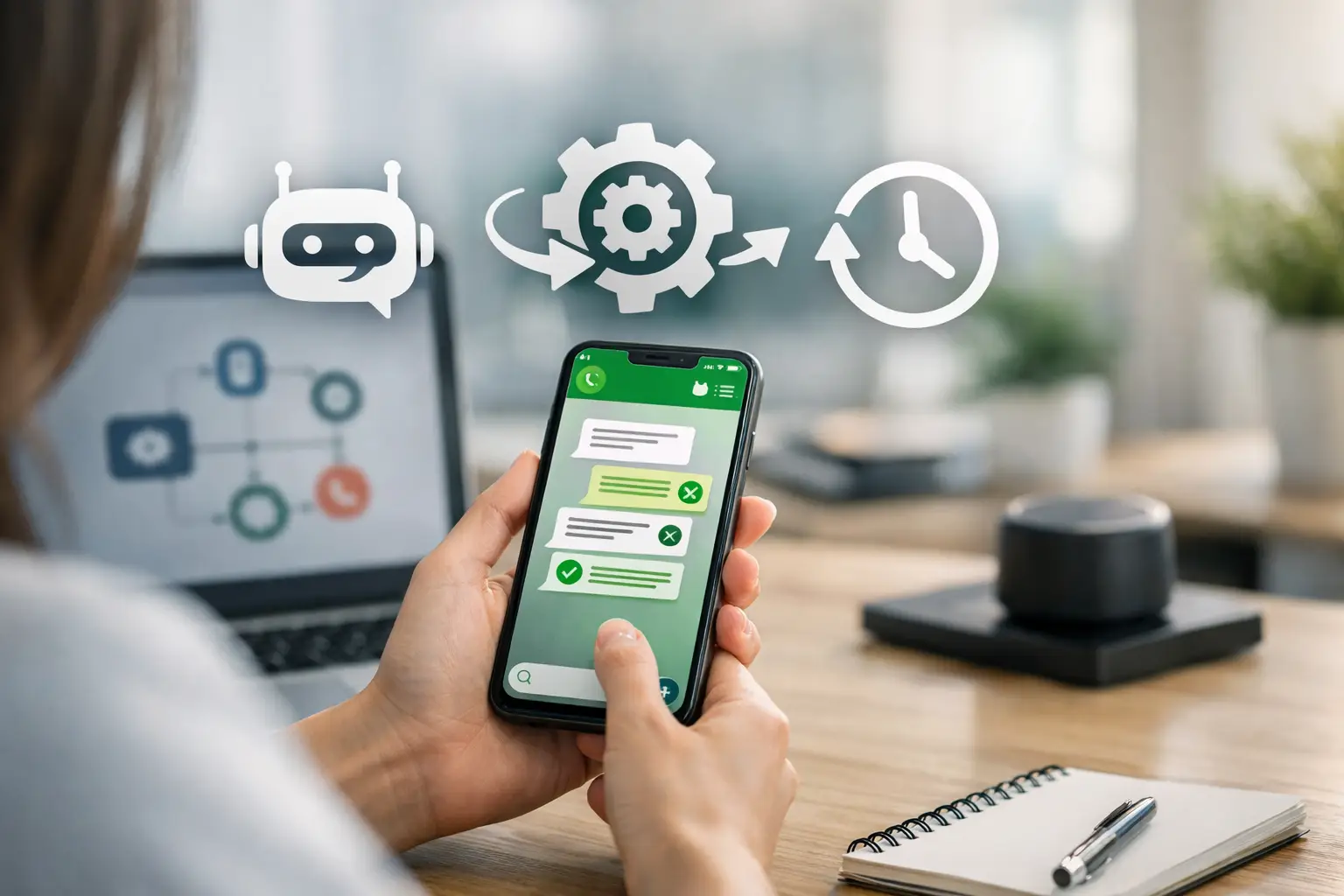
A missed WhatsApp message at 6.15pm can become a missed booking by 6.30pm. For a small business, that is not a minor admin issue. It is a customer who may book elsewhere, a diary gap that stays empty, and another task waiting for you when you are trying to finish the day.
WhatsApp business automation gives you a practical way to respond faster without being tied to your phone. Done well, it handles the repeatable parts of customer communication - answering common questions, collecting booking details, sending reminders and following up after a job - while keeping the personal service customers expect.
The aim is not to turn every conversation into a bot. It is to build a clearer process around the way you already work, so fewer good leads slip through the cracks and less of your time disappears into chasing, copying and pasting.
What WhatsApp business automation should do
The best automation starts with the customer journey, not the software. A plumber, beauty therapist, restaurant and consultant may all use WhatsApp, but the useful moments for automation will be different.
For most service businesses, the journey is familiar. Someone makes an enquiry. They need an answer, a price guide or an available time. They book, reschedule or ask a question. After the appointment, there may be an invoice, a review request and a reason to come back.
WhatsApp can support each of those stages, but only where an automated message genuinely makes the next step easier. That might mean an instant acknowledgement when you are with a customer, a short booking form sent after a new enquiry, or a reminder the day before an appointment. It does not mean sending messages simply because you can.
A useful system should reduce admin, improve response times and keep your customer records accurate. If it creates another inbox to check or another dashboard nobody uses, it is not solving the real problem.
Respond promptly without promising too much
A simple first reply can make a meaningful difference, especially outside working hours. It can confirm that the enquiry has been received, set a clear expectation for when someone will reply, and offer an immediate next action.
For example, a home service business could ask for a postcode, a brief description of the issue and a photo where relevant. A salon could offer a link-free choice of service categories and invite the customer to select a preferred day. The customer feels looked after, while the business receives the information needed to move the booking forward.
The important detail is honesty. Do not present an automated response as a live person. If an AI receptionist is handling the first conversation, it should be clear, helpful and able to pass the conversation to a human when the question becomes specific, sensitive or urgent.
Turn enquiries into organised booking requests
Many businesses lose time because enquiries arrive in five different forms. A customer messages on WhatsApp, another fills in a website form, someone calls, and the details end up in notes, inboxes and memory.
A better setup captures WhatsApp enquiries in one customer record. The system can tag the lead by service, location, urgency or source, then prompt the right next action. For a decorator, that may be arranging a site visit. For a personal trainer, it may be booking a consultation. For a café taking event bookings, it may be confirming party size and date.
This is where automation earns its place. It keeps the conversation moving while making sure the details do not need to be entered twice. You still decide which jobs to take and what to charge. The system simply makes the route from enquiry to confirmed booking less messy.
Building WhatsApp business automation around your workflow
Before choosing features, look at the messages you send repeatedly in a normal week. These are usually the first candidates for automation. They tend to be predictable, time-sensitive and easy to standardise without sounding cold.
For a booking-led business, the strongest workflow often begins with an enquiry acknowledgement and qualification questions. Once a booking is confirmed, the customer receives the essential details: date, time, location, preparation instructions and a route to reschedule if needed. A reminder can follow at the right interval, reducing no-shows without requiring you to chase every appointment manually.
After the service, the workflow changes. A thank-you message can ask whether everything was satisfactory. Customers who are happy can be invited to leave a review, while anyone with a concern can be encouraged to share feedback privately first. That gives you a chance to resolve an issue properly rather than discovering it later in a public review.
Finally, rebooking prompts can bring previous customers back at a sensible time. The right timing depends on the service. A barber may follow up after a few weeks; an accountant may have seasonal touchpoints; a boiler engineer may work around an annual service schedule. Generic messages sent too often quickly become noise. Relevant reminders feel useful.
Keep human handover in the process
Automation is excellent at routine communication. It is less reliable when judgement, reassurance or a tailored quote is required. A customer dealing with an emergency leak does not need a long menu of options. Someone asking about a treatment with health considerations needs an informed human response. A high-value commercial enquiry may deserve a call rather than a sequence of messages.
Set clear handover rules from the start. The system should flag urgent terms, unusual requests, complaints and high-value opportunities for a member of your team. It should also give customers an easy way to ask for a person.
This is not a limitation. It is the point. Good automation protects your time for conversations where your expertise matters most.
Use the right data, not more data
Small businesses rarely need an enterprise-level CRM packed with fields nobody will complete. They need a useful record of who the customer is, what they asked for, what has been booked, what was said last, and what should happen next.
If WhatsApp conversations sit alongside booking information, service history and follow-up status, you can respond with context. You are not asking a returning customer to repeat their details or searching through old messages to remember the last job.
Keep the data collection proportionate. Ask only for information needed to provide the service, store it securely, and make sure customer permissions are handled properly. WhatsApp messages are personal by nature. Marketing or rebooking communications should be welcome, relevant and easy to stop.
Where small businesses get it wrong
The most common mistake is automating before the underlying process is clear. If your booking rules are inconsistent, prices change without explanation or nobody owns the follow-up, an automated system will repeat that confusion faster.
Another mistake is trying to replace every human interaction. A rigid chatbot can frustrate customers who simply want a quick answer. Short, well-written messages and clear routes to a person will usually outperform a complicated conversation tree.
It is also worth avoiding a stack of disconnected tools. One app for forms, another for bookings, another for messages, another for reviews and a spreadsheet to hold it together can look affordable at first. The hidden cost is the time spent switching between systems and fixing gaps manually.
A tailored setup may include fewer tools, but it should connect the essentials: enquiry capture, customer records, bookings, reminders, follow-up and review management. Nothing more than you need.
Start with one workflow that costs you time
You do not need to automate your whole operation in one go. Start with the point where leads, time or customer confidence are most often lost. For many businesses, that is the gap between a new enquiry and a proper response. For others, it is missed appointments, inconsistent review requests or customers who never hear from them again after the first job.
Write down what happens now, including the manual steps. Then decide what the customer should receive, what information your team needs, and when a human should take over. Build and test that one flow before adding more.
At EKKO, this is the thinking behind systems such as EKKO Loop®: practical automations built around booking intake, reminders, post-appointment messages, review requests and rebooking prompts. The technology matters, but the day-to-day outcome matters more. You should be able to see where each customer is in the process without becoming an expert in software.
The strongest WhatsApp setup will not feel flashy. It will feel like your business is more responsive, more organised and easier to deal with - even on the days when you are fully booked.
Need this built for your business?
EKKO builds affordable websites, custom CRMs and automated follow-up systems for small businesses, sole traders and startups. Contact us for a custom quote.
More from the EKKO Journal
Small Business Website Trends That Earn Enquiries
Small business website trends for 2026: faster pages, clearer journeys, useful automation and stronger proof that help turn enquiries into loyal customers.
Small Business Automation Trends That Pay Off
Small business automation trends are moving beyond flashy tools towards practical systems for enquiries, bookings, follow-ups, reviews and repeat trade.
Spreadsheets Versus CRM Workflows: When to Switch
Spreadsheets versus CRM workflows: learn when a spreadsheet is enough, where it creates risk, and how tailored systems save time for busy small firms.